Stump Grinding Insurance
Verify Stump Grinding Insurance in 15 Minutes for Homeowners

Insurance coverage for stump grinding is conditional, not automatic. Most homeowners policies pay for tree and stump removal only when a covered peril, like a storm or lightning strike, actually damages a structure. Before you call a contractor, photograph the damage, contact your insurer to start the conversation, and confirm your contractor carries valid coverage with a Certificate of Insurance you verify yourself.
TL;DR:
- Insurance coverage for stump grinding depends on whether the tree fell due to a covered peril and the insurer’s specific policy terms, often excluding preventative removal.
- Many policies limit debris removal payments to $500 to $1,000 per incident, and stump grinding is often billed separately from tree removal, requiring clear confirmation.
- Verifying a contractor’s insurance involves requesting an official Certificate of Insurance directly from the insurer and confirming policy details via a phone call to avoid fakes or lapses.
- Homeowners should photograph damage, contact their insurer first, and get multiple written estimates before authorizing any work or signing assignment of benefits forms.
- Warning signs include altered COIs, refusal for direct insurer confirmation, low liability limits, and pressure tactics, all of which indicate the need to seek other contractors.
Table of Contents
- Does Homeowners Insurance Cover Tree Removal and Stump Grinding?
- How to Verify a Contractor’s Insurance in About 15 Minutes
- What to Do First: A Practical Sequence After Storm Damage
- Red Flags That Mean You Should Walk Away
- Roberto’s Approach to Insured Stump Grinding
- Get an Insured Stump Grinding Quote Without the Guesswork
- Where to Verify These Insurance Facts Yourself
- Sources
- FAQ
Does Homeowners Insurance Cover Tree Removal and Stump Grinding?
Coverage hinges on one question: did the tree fall because of a covered peril, or did it just need to go? A “covered peril” typically means wind, lightning, hail, or another sudden event named in your policy. If a storm drops a tree on your roof, most standard homeowners policies pay to remove that tree and repair the damage. If the same tree has been leaning dead in your yard for three years and you finally decide to take it down, that’s preventative removal, and insurers routinely deny it.
Insurers cap what they’ll pay for removal, too. Debris removal limits commonly run $500 to $1,000 per tree, or a percentage of your dwelling coverage, whichever your policy specifies. Your deductible applies before any of that kicks in, so a small job might not clear the threshold worth filing a claim over.
Here’s where things get murky for a lot of homeowners: stump grinding itself.
- Some policies fold stump removal into debris removal when the fall was a covered event.
- Many insurers treat grinding the stump down as a separate, unrelated expense, even when they covered the tree removal.
- The distinction between tree removal and stump removal often isn’t spelled out clearly in plain-language policy summaries, so you have to ask.
- State rules and individual carrier practices vary enough that a call to your agent beats guessing.
Get this in writing before work starts. Ask your adjuster directly whether stump grinding is included in your settlement or billed separately, and get that answer in an email you can reference later. A written, itemized estimate that separates tree removal charges from stump grinding charges protects you either way, whether you’re filing a claim or paying out of pocket.
How to Verify a Contractor’s Insurance in About 15 Minutes
Confirming a contractor’s coverage isn’t complicated, but skipping it is how homeowners end up liable for someone else’s injury on their own property. Verification typically takes about 15 minutes if you follow these steps in order.
- Request an ACORD Certificate of Insurance (COI). This is the standard industry form. Check the named insured (does it match the company name on your quote?), the policy numbers, the coverage types, the limits, and the effective and expiration dates.
- Ask the insurer or broker to send the COI directly to you. A PDF forwarded by the contractor can be altered. A copy sent straight from the insurance company or agent is far harder to fake.
- Call the insurer yourself using a number you find independently on the insurer’s official website, not a number printed on the contractor’s paperwork. Confirm the policy is active and covers the type of work being done.
- Ask for proof of workers’ compensation. If a worker gets hurt grinding a stump on your property and the company has no workers’ comp, you can be pulled into that liability.
- Request to be named as an additional insured for larger jobs. This extends a layer of the contractor’s liability coverage to you directly.
If anything about the COI looks off, blurry text, a policy number the insurer can’t locate, a business name that doesn’t quite match, stop. Independent verification is the single most reliable safeguard against a fabricated or lapsed policy, and it costs you nothing but a phone call.
Pro Tip: Save the insurer’s confirmation, whether it’s an email or a name and time from your phone call, in the same folder as your written estimate. If anything goes wrong later, that paper trail is what protects you.
What to Do First: A Practical Sequence After Storm Damage
Safety comes before paperwork. Stay away from any downed power lines or a structure that looks unstable, and don’t let anyone, including a contractor, approach a hazard before it’s been assessed. Once the immediate danger is clear, photograph everything: the tree, the stump, the damage to your roof or fence, from multiple angles and distances.
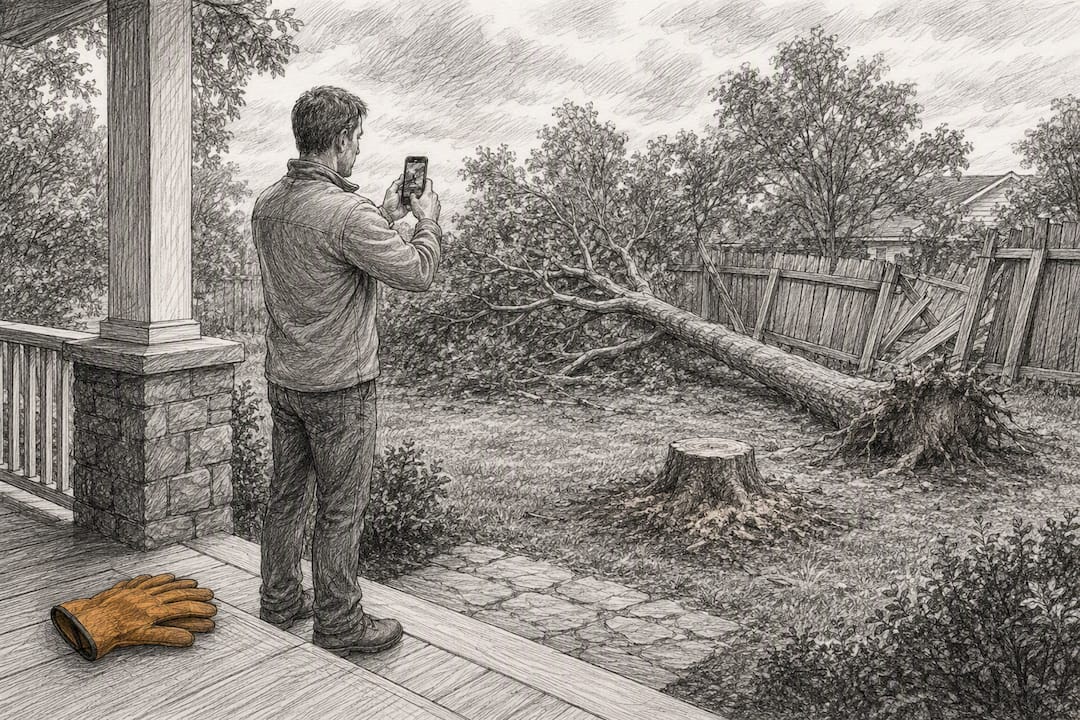
Call your insurer before you call a contractor. Open a claim if a covered structure took damage, and ask your adjuster directly about your deductible and your policy’s debris-removal limit. This conversation, detailed further in guidance for homeowners after storm damage, shapes what you can expect the insurer to pay before you commit to any contractor.
From there:
- Get at least two written estimates, each itemizing tree removal and stump grinding as separate line items.
- Read anything before you sign it. If a contractor asks you to sign an Assignment of Benefits (AOB), understand that the NAIC warns this can hand over control of your claim to the contractor, who then deals directly with your insurer on terms you may not fully see.
- Confirm your contractor will call 811 for a utility locate before any grinding starts. Skipping this step risks hitting a gas or utility line.
Red Flags That Mean You Should Walk Away
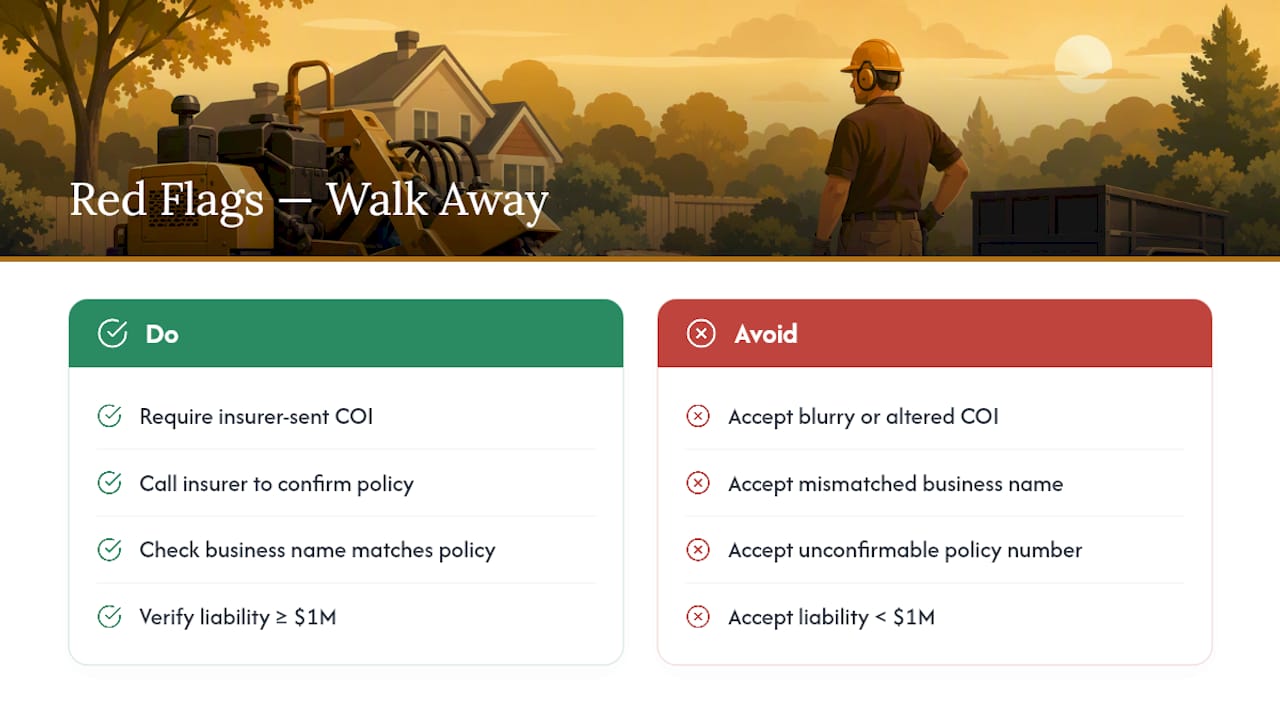
Some warning signs are obvious once you know to look for them. A blurry or altered COI, a business name that doesn’t match the policy, or a policy number the insurer can’t confirm are all disqualifying. So is any liability limit below the commonly recommended $1 million per occurrence, or a policy that’s already expired.
Refusal is its own red flag. If a contractor won’t let the insurer send you the COI directly, or won’t let you call the insurer to confirm it, that hesitation tells you something. Watch for claims like “we’re covered under your homeowner policy” (not how liability works) or “we’re FEMA certified” (FEMA doesn’t certify contractors). Pressure to skip permits, demands for large upfront cash payments, or a refusal to put anything in writing are all reasons to end the conversation and call the next name on your list.
Roberto’s Approach to Insured Stump Grinding
We built our process around the questions this article just walked you through, because we’ve fielded them from homeowners for years. This contractor is fully insured, and provides a Certificate of Insurance on request. We offer free on-site quotes within one to two business days, and every quote separates stump grinding pricing from any other work, so you know exactly what you’re paying for.
Every stump we grind goes below grade, which means your yard is ready for sod, mulch, or landscaping immediately, not months later. We back every job with a 30-day satisfaction guarantee. If you’re comparing contractors, ask us the same verification questions you’d ask anyone else, and compare our written estimate against theirs.
— Roberto
Get an Insured Stump Grinding Quote Without the Guesswork
This stump grinding service provides a Certificate of Insurance promptly upon request, and quotes include tree removal and stump grinding as separate, clearly labeled line items.
They serve multiple cities in North Atlanta and offer on-site visits within one to two days for free, no-pressure quotes. Customers can request the insurer to send the COI directly, ask for proof of workers’ compensation on larger jobs, and should get everything in writing before work begins. Some jobs come with a satisfaction guarantee.
Ready to see what a properly insured stump grinding job looks like? Request your free on-site quote and ask us the same questions this article just walked you through. We’ll answer every one of them before we ever pick up a grinder.
Where to Verify These Insurance Facts Yourself
For direct confirmation of what’s covered by contractor liability standards and how Assignment of Benefits agreements actually work, go straight to the source rather than relying on a contractor’s summary.
Sources
- NAIC – Assignment of Benefits consumer warning
- Does homeowners insurance cover tree removal? | TreeLaws
- How to verify contractor insurance | CheckLicensed
- How to spot a fake certificate of insurance | Great American Insurance Group
FAQ
Does Homeowners Insurance Always Pay to Remove a Fallen Tree?
No. Coverage generally applies only when a covered peril like wind or lightning caused the tree to fall onto a structure, and even then, insurers often cap payouts at $500 to $1,000 per tree or a percentage of dwelling coverage. Preventative removal of a healthy or already-dead tree is almost never covered.
Is Stump Grinding Included in Debris Removal Coverage?
Sometimes, but not reliably. Insurers may bundle stump removal into debris removal or bill it as a separate, uncovered cost, so confirm directly with your adjuster and get it itemized on your written estimate.
How Do I Know a Contractor’s Certificate of Insurance Is Real?
Have the insurer or broker send the COI directly to you rather than accepting a copy from the contractor, then call the insurance company using a number from their official website to confirm the policy is active and covers the work.
Should I Sign an Assignment of Benefits Form for Stump Grinding Work?
Be cautious. The NAIC warns that an AOB lets a contractor deal directly with your insurer, which can mean you lose control over how your claim is negotiated and settled.
What Should I Ask For When Getting a Stump Grinding Quote?
Ask for a Certificate of Insurance, proof of workers’ compensation, and a written estimate with tree removal and stump grinding listed as separate line items. Roberto’s Stump Grinding provides all three along with a free on-site quote within one to two days.
Recommended
Get a free in-person quote.
We come out, walk the property with you, and give you the number on the spot, free, no obligation, across 18 north Atlanta cities.
Call (770) 309-1050