
Mulch For Clay Soil
Top Dress This Weekend: Mulch for Clay Soil with 6–12 Month Results
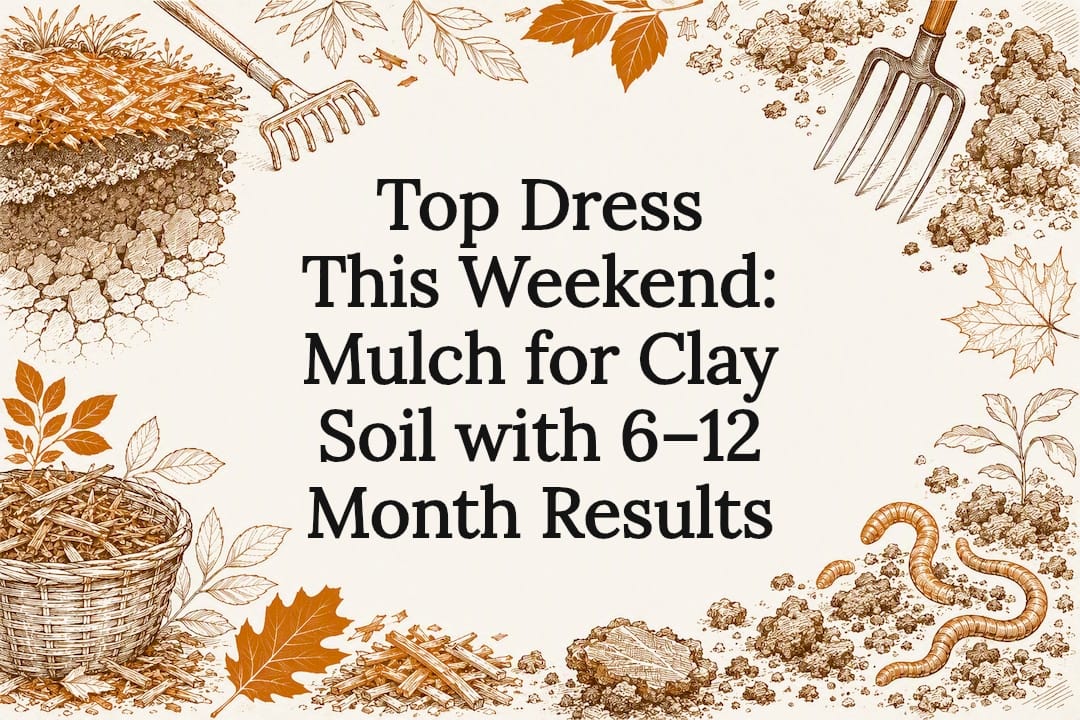
Finished compost, leaf mold, and shredded leaves are the best mulches for clay soil because they feed soil biology fast and build the aggregates clay lacks. The single best move you can make this weekend is topdressing beds with 1 to 2 inches of compost, then covering that with 2 to 3 inches of shredded leaves or wood chips, or building a full sheet-mulch layer with cardboard underneath. Skip sand entirely, and never work clay while it’s wet.
TL;DR:
- Compost and leaf mold rapidly improve clay soil by feeding fungal networks that promote aggregate formation and enhance soil structure.
- Shredded leaves provide an effective, low-cost mulch option that enhances water infiltration and weed suppression when shredded first.
- Avoid adding sand and never till wet clay, as these practices can worsen compaction and create a denser, less fertile soil layer.
- Regular topdressing with compost and mulch over several years gradually transforms soil texture, with visible improvements typically within 12 to 36 months.
- Professional mulch installation is recommended for large or inaccessible areas to ensure proper layering and achieve faster, more reliable results.
Table of Contents
- What’s the Best Mulch for Clay Soil?
- How Does Mulch Actually Change Clay’s Structure?
- How Do You Apply Mulch to Clay Soil?
- What Should You Never Do to Clay Soil?
- How Long Does It Take to Improve Clay Soil?
- What Else Helps Clay Soil Besides Mulch?
- What to Expect From Professional Mulch Delivery and Installation
- Why Slow, Biological Soil Building Beats Quick Fixes
- Get Mulch Delivered and Installed Without the Guesswork
- Where to Learn More About Clay Soil Improvement
- Sources
- FAQ
What’s the Best Mulch for Clay Soil?
Not all organic matter earns its place on heavy clay. Some materials break down fast enough to feed hungry soil biology right away. Others sit on the surface for a year doing little more than suppressing weeds. Here’s how the main options stack up.
Leaf mold and finished compost deliver the fastest visible results of anything you can put on clay. Leaf mold is just decomposed leaves, aged a year or two until they crumble like coffee grounds, and it’s loaded with the fungal filaments that clay soil desperately needs. Finished compost works the same way but faster, since it’s already gone through active decomposition. N.C. State Extension’s Extension Gardener Handbook lists compost as the primary recommendation for improving structure and fertility in problem soils, and for clay specifically, it’s hard to beat.
Shredded leaves are the free version of leaf mold, and they’re better than most bagged products if you shred them first. A whole leaf mats down and can actually shed water like a shingle; a shredded leaf settles into a loose blanket that lets rain through while still blocking sunlight from weed seeds. Run a mower over a pile in the fall, bag the shreds, and you’ve got a season’s worth of mulch for nothing.
Straw and clean grass clippings work well around vegetables, where you want something light that won’t compact. Straw breaks down in a single season, so it needs replenishing, but it’s cheap and doesn’t rob the soil of nitrogen the way fresher woody material can. Grass clippings should go on in thin layers only. A thick, wet mat of clippings turns slimy and can suffocate the surface instead of protecting it.
Wood chips and composted bark are the workhorses for permanent beds, paths, and around shrubs and trees. Fresh wood chips are fine on the surface. The problem only starts if you till them into the soil, where soil microbes will pull nitrogen from the surrounding dirt to break the wood down, starving nearby plants. Left on top, chips age gracefully over 1 to 2 years and slowly enrich the soil underneath as the bottom layer breaks down against the clay.
Pine straw and bark fit ornamental beds and acid-loving plants like azaleas and blueberries, but they don’t do much for clay’s structure. Extension guidance from Buncombe County’s Master Gardener program notes that pine straw won’t improve clay structure the way compost or shredded leaves will, and it’s flammable enough that you should keep it away from foundations and decks. Use it where it looks good, not where you’re counting on it to fix drainage.
- Leaf mold and finished compost: fastest structural improvement, best all-around choice
- Shredded leaves: free, effective, needs a mower or shredder
- Straw: good for annual vegetable beds, breaks down quickly
- Wood chips and bark: best long-term surface protection for shrubs and perennial beds
- Pine straw: fine for ornamentals, not a clay-fixing material
How Does Mulch Actually Change Clay’s Structure?
Clay particles are microscopically flat and tend to stack together like wet playing cards, which is exactly why clay drains poorly and turns brick hard when it dries. Organic mulch breaks that pattern from the top down, not by force but by feeding the biology that pries the particles apart.
As mulch decomposes, it triggers a process called flocculation, where organic compounds cause individual clay particles to clump into larger aggregates instead of packing flat. Fungal networks play a major role here. Many soil fungi produce a sticky glycoprotein called glomalin that literally glues soil particles into stable crumbs, creating the pore spaces water and air need to move through. A 2024 review in Frontiers in Agronomy found that mulched soils, and especially those topped with composted yard waste, showed higher nutrient levels and better moisture retention than bare soil, largely because that biological activity stays active longer under a protective layer.
Earthworms do the physical labor. They pull surface organic matter down into their burrows, mixing decomposed material into the top several inches without you ever picking up a shovel. Over time, those worm channels become permanent drainage pathways, the kind you can’t recreate by digging because digging collapses them. Practitioner accounts, including a detailed breakdown from GrowPerma on rebuilding heavy soil, describe this as mimicking a woodland floor: organic matter arrives from above, and biology carries it down.
Mulch also acts as insulation against clay’s biggest structural enemy, which is the shrink-swell cycle. Bare clay expands when wet and contracts hard when it dries, and that repeated stress is what creates surface crusting and the deep cracks you see in August. A 2 to 3 inch mulch layer buffers soil temperature and moisture swings enough to slow that cycle dramatically.
Compare that to sand or a quick chemical fix, and the difference is stark. Sand mixed into clay at typical garden ratios does nothing to break up the flat particle stacking. In fact, Proven Winners’ guidance on gardening in clay points out that a light sand addition just fills the gaps between clay particles, creating something closer to concrete. Organic matter works because it’s biologically active. Sand just sits there.
How Do You Apply Mulch to Clay Soil?
The method matters as much as the material. Clay punishes shortcuts, and the wrong timing can undo months of progress in an afternoon.
Sheet mulching is the fastest way to convert a patch of compacted clay into a plantable bed without a shovel touching the ground. This is the no-dig approach, and it works because it builds structure from the surface down rather than disturbing what little structure clay already has.
- Mow or cut existing vegetation short, and water the area if it’s dry.
- Lay overlapping cardboard sheets across the bed, at least two layers thick, with no gaps at the seams.
- Spread 4 to 6 inches of finished compost directly on top of the cardboard.
- Cover that with 2 to 3 inches of a protective mulch, such as shredded leaves or wood chips.
- Water the whole layer thoroughly to help it settle and start breaking down the cardboard.
- Wait 4 to 6 weeks before planting seedlings, or cut small planting holes through the layers immediately if you need to plant sooner.
Practitioner reports on sheet mulching, including the GrowPerma case data, show measurable gains in water infiltration and topsoil quality within 6 to 12 months, which is fast for a technique that involves zero tilling.
Topdressing is the maintenance version, used on beds that are already planted or established. Once a year, ideally in fall or early spring, spread 1 to 2 inches of finished compost around existing plants without piling it against stems or trunks. Follow that with a 2 to 3 inch layer of protective mulch on top. N.C. State Extension’s guidance on soils treats this annual topdressing as the backbone of long-term clay improvement, more effective over several years than any single big intervention.
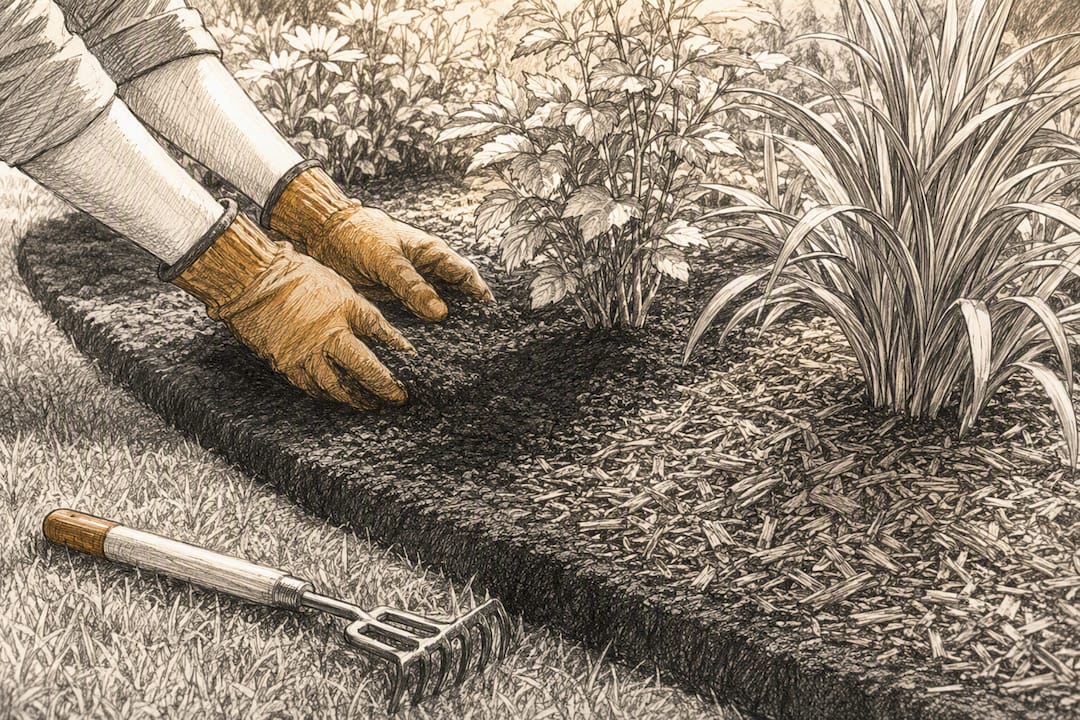
Pro Tip: Never walk on wet clay, mulched or not. Compaction from foot traffic on saturated clay can undo a full season of biological improvement in a few footprints, since it collapses the very pore structure you’re trying to build.
As for tools, skip the rototiller on clay whenever you can. Tilling wet clay smears the particles into an even denser layer just below the surface, called a tillage pan, that can be worse than the compaction you started with. A broadfork is the better option when you genuinely need to loosen deep soil. It’s a manual tool with long tines you step into and rock back, which fractures compacted layers without inverting or pulverizing the soil the way a tiller does. Save the broadfork for once, at the start, if at all. After that, let mulch and biology do the rest.
What Should You Never Do to Clay Soil?
A few habits show up constantly in home gardens, and every one of them makes clay worse instead of better.
Adding sand is the most common mistake. The ratio needed to actually change clay’s texture is enormous, something like 50% sand by volume worked in evenly, which isn’t realistic for a garden bed. At the smaller amounts people typically add, sand fills the pore spaces between clay particles and creates a denser, harder mix. OSU and RHS guidance both steer gardeners toward organic matter instead, for exactly this reason.
Tilling wet clay compacts it below the depth of the tiller blades, creating a hardpan that can persist for years. If you must mechanically break up clay, wait until it’s dry enough to crumble in your hand rather than smear.
Tilling fresh wood chips into the soil causes temporary nitrogen tie-up, where the microbes decomposing the chips consume nitrogen that would otherwise feed your plants. Left on the surface as mulch, this isn’t a problem, since the tie-up happens in a thin zone at the chip-soil interface, not throughout the root zone.
Peat moss and “fast fix” soil products deserve skepticism. Peat holds water well but contributes little to the biological rebuilding clay actually needs, and it’s not a renewable resource. Unverified powders and additives marketed as instant clay busters rarely have independent data behind them.
The safer path is boring but proven: compost, cover crops, and sheet mulching.
- Skip sand additions entirely
- Never till or dig clay while it’s wet
- Keep fresh wood chips on the surface, not mixed in
- Treat peat moss and “miracle” soil additives with caution
- Default to compost and mulch for anything clay related
How Long Does It Take to Improve Clay Soil?
Expect the first signs within a season, and real structural change over a few years.
In the first few months after sheet mulching or heavy topdressing, you should notice better water infiltration in the top 4 to 6 inches. Rain that used to pool now soaks in faster, and the surface stops forming that hard, cracked crust after dry spells. This early change is mostly biological activity responding to the new food source you’ve laid down.
By the 12 month mark, with consistent compost applications, most gardeners see a measurable difference in how the soil handles a shovel. It’s no longer solid clay all the way down. There’s a looser, darker layer forming at the surface. The deeper structural change, the kind where you can dig a full spade’s depth without fighting the ground, tends to show up over 18 to 36 months of consistent topdressing, mulching, and cover cropping.
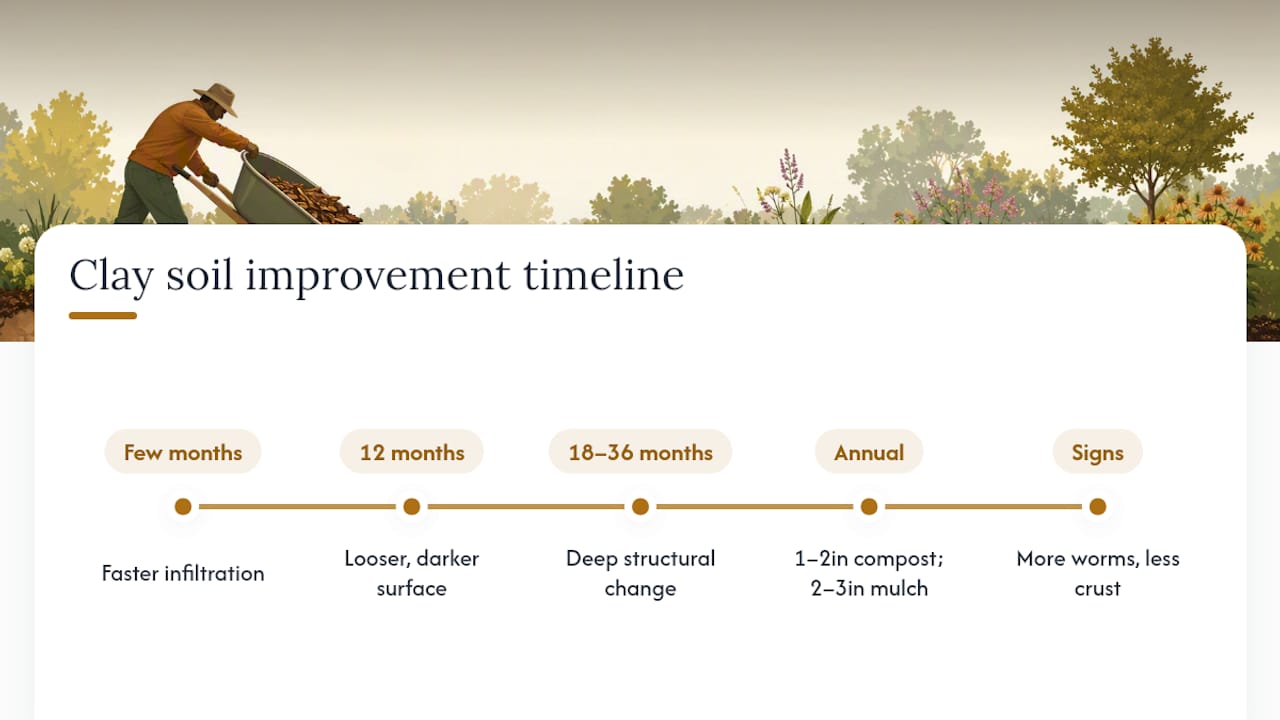
For maintenance, plan on 1 to 2 inches of compost annually plus a fresh 2 to 3 inch mulch layer as the previous one breaks down. That’s the pace N.C. State Extension recommends for sustaining gains rather than losing ground each winter.
The clearest signs your strategy is working: more earthworms when you dig, less surface crusting after rain, and soil that crumbles instead of clumping when you squeeze a handful.
What Else Helps Clay Soil Besides Mulch?
Mulch does most of the work, but a few companion tactics speed things up meaningfully.
Cover crops are the single best complement to mulching because their roots do underground what mulch does on the surface. Daikon radish sends a thick taproot deep into compacted clay, then rots in place over winter, leaving a channel for water and roots. Cereal rye and hairy vetch build a dense fibrous root mass that adds organic matter and improves tilth when you cut the crop at the base rather than pulling it, leaving the roots to decompose undisturbed.
Combining compost with aged manure accelerates biological activity, since manure brings a different mix of microbes and nutrients than plant-based compost alone. Keep manure well aged. Fresh manure can burn roots and introduce pathogens.
Raised beds and shallow swales solve the drainage problem mechanically while the biology catches up. A raised bed filled with quality soil gives roots an escape from waterlogged clay underneath, and a shallow swale, essentially a graded channel, redirects surface water away from problem areas without any digging into the clay itself.
Gypsum gets recommended constantly online, but it only helps sodic soils, meaning soils with excess sodium disrupting particle bonding. AgriPure’s amendment guidance is blunt about this: gypsum does nothing for standard clay and should only go down after a soil test confirms high sodium or SAR levels. Check your soil type and drainage constraints through the USDA Web Soil Survey before spending money on any mineral amendment.
- Daikon radish, cereal rye, and hairy vetch as clay-breaking cover crops
- Aged manure layered with compost for a biological boost
- Raised beds or swales for immediate drainage relief
- Gypsum only after a soil test confirms sodium is the actual problem
What to Expect From Professional Mulch Delivery and Installation
Most of what improves clay soil is patient, repeatable work. Professional mulch delivery and installation services handle the part that’s genuinely hard to do yourself: getting large volumes of quality mulch delivered and spread correctly across a full property.
Hiring a pro makes the most sense in a few situations. A yard with steep or awkward access, where hauling wheelbarrow loads of compost across a slope isn’t realistic. A property large enough that DIY topdressing would take weekends instead of hours. Or simply wanting the job done once, correctly, without wondering if the layer depth is right or the cardboard was overlapped properly for a sheet-mulch bed.
Many services start with a free on-site quote, typically scheduled within a few days of a request, so there’s no guessing at cost before committing. Crews often work fully insured, which matters when heavy material and equipment are moving around a residential property. Some installations may carry a satisfaction guarantee, giving homeowners a real window to see how the mulch settles and performs before considering the job finished.
For anyone weighing a weekend of hauling bags of compost against a scheduled delivery and spread, that’s the practical trade-off. One path costs time and a sore back. The other costs a service fee and gets it right the first time.
Why Slow, Biological Soil Building Beats Quick Fixes
The clay soil advice cycle has a predictable pattern. Someone gets frustrated with hard, cracked ground and reaches for the fastest-sounding fix: a bag of sand, a tiller, a product promising overnight results. Almost none of it works, and a lot of it makes the underlying problem worse.
Biological improvement is slower because it’s actually doing something. Fungal networks, worm activity, and aggregate formation take months to establish and years to mature, but they build a soil structure that holds up under normal garden use, rather than a temporary texture fix that reverts the moment you stop maintaining it.
That said, mechanical intervention has its place. A one-time broadfork pass on severely compacted ground, or bringing in a contractor to handle a large-scale mulch installation across a full property, isn’t cheating the process. It’s using the right tool for the scale of the problem. The mistake isn’t using equipment. It’s expecting equipment alone to substitute for the years of biological work that actually rebuild clay.
The gardeners who see the best results treat mulch as infrastructure they maintain every year, not a one-time purchase.
— Roberto
Get Mulch Delivered and Installed Without the Guesswork
Roberto’s Stump Grinding Services is the practical option when topdressing your whole property with compost and mulch sounds right in theory but wrong for a Saturday afternoon. Rather than hauling bags across a yard in stages, you get a delivery and spread scheduled around your timeline, with the material distributed at the depth your beds actually need.
Such services typically cover mulch delivery and installation, plus debris removal if old mulch or yard waste needs clearing first, across various areas. Projects often start with a free on-site quote, usually scheduled soon after a request, so you know the cost and timeline before anything is scheduled. Crews are generally fully insured, and some installations may be backed by a satisfaction guarantee while the mulch settles in.
If you’ve got a large bed, a steep yard, or simply don’t want to spend a weekend wheelbarrowing compost, request a quote through the mulch delivery and installation page and get a firm plan for your property.
Where to Learn More About Clay Soil Improvement
A few sources go deeper than most garden blogs if you want to verify the science or plan a larger project.
- N.C. State Extension’s Extension Gardener Handbook covers soil texture, organic matter, and nutrient management with the kind of detail a state extension service backs with research.
- The Frontiers in Agronomy 2024 review summarizes multiple studies on mulching’s effects on moisture retention and soil nutrients.
- AgriPure’s guide to amending heavy clay breaks down when gypsum actually applies versus when compost is the better call.
- The USDA Web Soil Survey lets you check your property’s soil texture and drainage constraints before choosing amendments.
- Local resources like the Missouri Department of Conservation’s seedling program show the kind of low-cost sourcing options available in many regions for mulch and cover-crop material.
Sources
- Frontiers in Agronomy (2024) — review on mulching benefits
- N.C. State Extension — Extension Gardener Handbook: Soils and plant nutrients
- AgriPure — Amend heavy clay soil: compost, biochar & soil fertility guide
- USDA Web Soil Survey
FAQ
What mulch is best for clay soil?
Finished compost and leaf mold are the best mulches for clay soil because they feed the fungal and microbial activity that builds aggregate structure fastest, followed by shredded leaves as a free alternative.
What is the best thing to add to clay soil?
Compost is the single most effective addition for clay soil, recommended by extension services over gypsum, sand, or peat for building long-term structure and fertility.
Do coffee grounds improve clay soil?
Coffee grounds can add organic matter in small amounts, but they’re not a substitute for compost or leaf mold. They work best mixed into a compost pile rather than applied thickly on their own.
What breaks down clay soil fast?
Nothing breaks down clay overnight, but sheet mulching with cardboard, compost, and a protective mulch layer produces measurable infiltration improvements within 6 to 12 months, faster than any single amendment alone.
Should I till my clay soil to loosen it?
Avoid tilling clay soil, especially when wet, since it often creates a compacted tillage pan just below the surface. A broadfork or consistent mulching builds lasting structure without that risk.
Recommended
Get a free in-person quote.
We come out, walk the property with you, and give you the number on the spot, free, no obligation, across 18 north Atlanta cities.
Call (770) 309-1050